
Research Interests
This page is still under construction and will be up to date soon. If you would like to know more about our current research, contact Dr. Aponick or any of our current students for more information in the meantime.
We are an organometallic lab focused on the development of new synthetic methodologies to address difficulties in target-oriented synthesis. To control specificity, nature has evolved enzymes that perform chemical reactions with exquisite chemo-, diastereo-, and enantioselectivity. Our main goal is to develop new small molecule transition metal catalysts that exhibit synthetically useful levels of selectivity in new chemical transformations. The significance of this work lies in its application to synthesis. Particular attention is given to bioactive natural products with interesting molecular architecture, wherein the objective is to develop efficient synthetic strategies that facilitate extensive structural modifications to probe biological activity. Students in our group will be exposed to the vast repertoire of reactions and learn the analytical skills to plan, execute and optimize reaction sequences.
Ever since the development of the Wacker Oxidation in 1959, countless groups have probed the usage of Pd to activate olefins for the construction of interesting and useful molecules. A key intermediate within these transformations arises from nucleopalladation of the alkene, which can be followed by reductive elimination to yield difunctionalized products. With a chiral ligand bound to Pd, these products can be chiral with potentially high ee. We are highly interested in such reactions both from inter- and intra-molecular substrates.
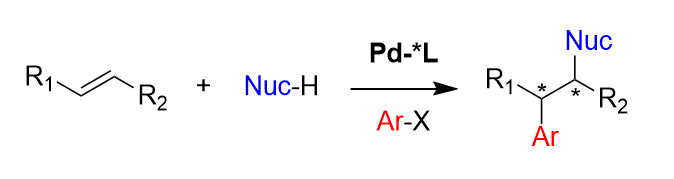
Palladium-catalyzed alkene difunctionalization
Previously, we have shown that we are able to asymmetrically dearomatize simple heterocyclic feedstocks such as quinoline (Pappopula et al, 2015) and pyrazine (Ketelboeter et al, 2024), using Cu-StackPhos bound acetylides. These are methodologies that create privileged scaffolds and help fill voids within the field of enantioselective dearomatization of heterocycles. We have a continued interest in expanding the scope of this chemistry in other new, creative ways.
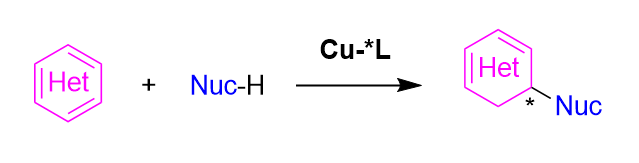
Copper-catalyzed dearomative transformations
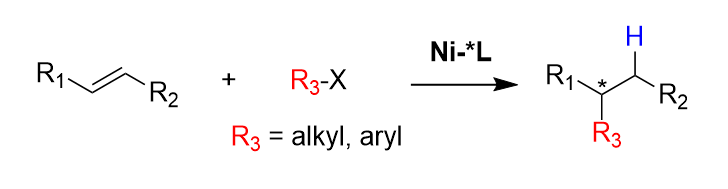
Nickel-catalyzed hydrofunctionalization
Carbamate-protected 1,4-dihydropyrazines are a unique molecule that don’t necessarily behave in the way one might think. This was discovered amidst the pyrazine dearomatization project, and we are interested in probing its properties and reactivity. Ongoing work is being done in this arena utilizing the catalytic properties of Nickel.
Utilizing a StackPhim promoted asymmetric A3 coupling previously developed within our group, we envisioned employing this as a first step in the construction of Aspidospermidine, an indole alkaloid derived from the bark of the “Quebracho” tree (insert reference?). The various species of Aspidosperma are known to have strong anti-inflammatory, analgesic, and antitumor properties (reference?).
Total synthesis
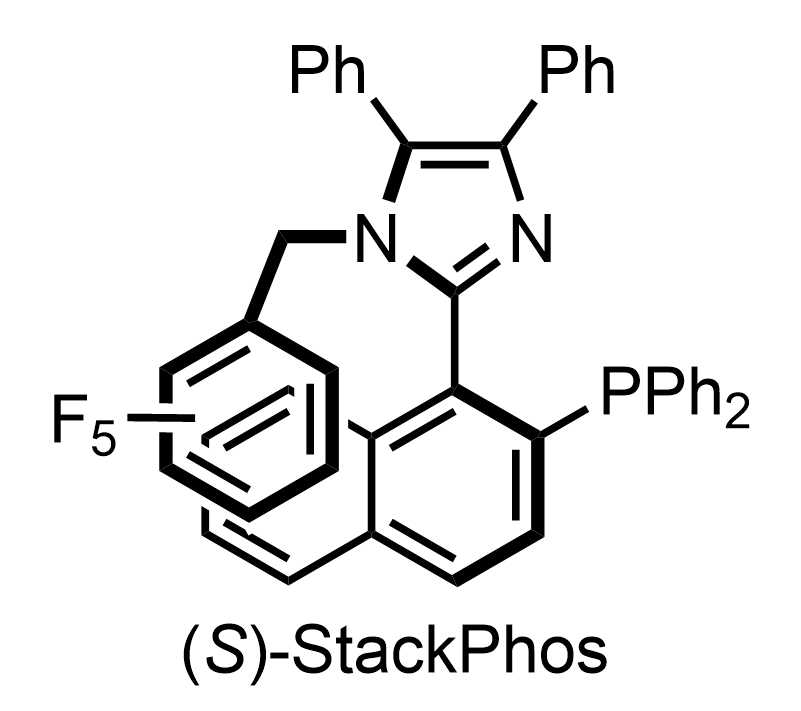
Transformations with our Ligand